
Cucumber
- Neelangi Mehta
- Apr 28, 2023
- 11 min read

" Hello readers, we are here with another piece about the coolest vein of food - 'Cucumber' It is a familiar vegetable which is unjustly only known for its cooling effect. But cucumber has more to it, mentioned in this article."
Cucumber, from the ‘cucurbitaceae/cucurbits’ or gourd family are scientifically named as ‘Cucumis Sativus’, is an annual warm-weather creeping vine plant. They are cousins of pumpkins, squashes, zucchinis and melons. Cucumber plant bears yellow flowers with coarse and bold leaves. These leaves are 4-5 lobed, triangular leaves of upto 10-40 cm wide in size.

The vine bearing the leaves, flowers and fruits is hairy in texture and can grow 6 ft long. The roots are lateral in structure and cover upto 30 cm of the area where it grows. Cucumis Sativus is also described as a monoecious plant as it bears both male and female flowers on the same stem, where the yellow male flowers (staminate) grow in a cluster and the yellow female flowers(pistillate) have thin pedicles in the centre.

Hermaphrodite flowers (both male and female characteristics) bear round fruits. Commercially, gynoecious hybrid cucumber plants are grown as naturally they produce female flowers but during hot and humid weather conditions, they produce only male flowers and give out more produce. Coming to the most consumed part of the plant, cucumber a.k.a. ‘false berry’ which has a thick, semi-soft rind, grows 3-25 inches long. The fruit goes through 2 stages of development: immature (green colour fruit due to chlorophyll located in the epidermis) & mature (yellow-white rind, epidermal area develops warty areas, three locules of soft tissues bearing seeds). Conclusively, these fruits appear to have green, yellow, white and orange colours.
The characteristics and appearance of the false berry plant are mentioned followed by the origins of the Cucumis sativus. Cucumber is a native to India, where it was a wild vegetation at first and then it was domesticated 3000 years ago, post which it was adopted by the Greeks, who called it ‘Vilwos’, and by Italy where it was called ‘Cetriolo’, where the romans grew fond of this crop and called it ‘Castravete’. The cucumber reached the middle east during the 6th & 7th century by the Greek, Syrian and Persian sources. The Romans took their favourite remedy of scorpion bites, bad eyesight and mice repellent to Europe during 9th century, where the French king Charlemagne grew ‘Concombre’ or cucumbers in his garden. It was introduced to England in the 13th century and was lost to get in trend again after 250 years. The Spainiards brought these coolant veggies to Haiti in 1490. The Europeans began trade with America which led to the European fur traders, trappers and bison hunters to trade using cucumbers and hence, America was introduced to cucumbers in the 15th century. In 18th century, medical journals warned about the dangers of consuming raw summer vegetables which caused an interruption in the trend of cucumbers. But its popularity was regained in the 19th century.
After a long travel, cucumber has developed a long list of varieties which developed when different countries cultivated this crop with different methods. These varieties are categorised under two main categories: Slicing & Pickling.
Slicing cukes: This type of cucumbers are eaten fresh, have a crisp, tender and juicy texture with thin, whitish green to dark green skin. The skin has mild and few spines on it. These cukes grow 4-12 inches long, certain varieties can also grow upto 25 inches long. Turkey comes first on the slicer cucumber producers’ list. Some varieties of slicing cukes are: Japanese, American, Armenian, English, Lemon, Tendergreen, Garden, Corinto, etc.
Pickling cukes: Picklers have a warty, bumpy and dense green skin with dark green to black spines. Its skin is thicker than that of the slicers, with a firmer flesh which holds its structure and crunchy texture even after pickling. Picklers are small in size as they grow upto 1-5 inches long. China is the leading country in pickler cucumber production. Varieties that fall under this category: Kirby, Gherkin, Korean, Northern Pickling, Maroon, Burpee, etc.
(*Some varieties like Persian and Lebanese can be categorised as both, slicers & plickers.)
Regardless of the categories or varieties of cucumber, the vegetable has a compound called cucurbitacin which is the cause of a bitter taste and gas build up- causing burp. Over consumption of this compound lead to toxic effects, but a controlled intake was a medicine for malaria and many other diseases. Cucumbers were then variated to harvest a burpless variety which did not have the bitter taste and excessive side effects on the consumer. The burpless cultivar is long, narrow, thin-skinned and seedless or has few seeds.
Here is a brief up about the varieties mentioned above along with some additional picklers and slicers:

Japanese: These slicers a.k.a. ‘Kyuri’ have a dark green, thin and bumpy skin. Kyuri is sweet in taste with a narrow shape and is as long as 24 inches. Due to its sweet taste which follows its crunchy texture, it is fit for
sandwiches and salads.

American: This dark green and straight slicer grows upto an average length of 8-10 inches. they are commonly sold in markets and stocked up annually, hence the skin is coated with wax to prevent moisture loss and extend its shelf life. This makes the skin glossy and gives a good appearance, but it is unfit to consume without being peeled and getting rid of the wax. These slicers are commonly used in salads, sandwiches, coolers for summers and smoothies.

Armenian: A.k.a Snakemelon, has thin, dark green skin when immature and light green or whitish-yellow skin when mature and grows upto 11-15 inches long within 55-75 days to be ready to harvest. Due to its length and narrowness, it has a snake like structure and grows on the ground. This slicer has soft seeds and can be eaten unpeeled in sandwiches, salads and grilled. These burpless slicers have a firmer texture compared to other slicers, hence, can be pickled as well.


English: This long and dark green, thin-skinned slicer has minimum seeds and a mild taste with ridges on the skin. These cukes are commonly used sake and cocktails due to its high water content and neutral flavour. This burpless slicer grows upto 12-24 inches long.

Lemon: The only lemony thing about this slicer type is the appearance which is yellow skin and a radius of utpo 2-3 inches. Its flesh is lime-green, burpless, sweet, crispy and is embedded with minimal seeds. Lemon cukes are harvested when fully ripe. They are a fast growing variety and easy to digest, native from India and Middle East. It grows in a hot climate and matures within 70 days. This variety is related more to muskmelon with a botanical name ‘Cucumis Melo Var Flaxuosus’.

Bush Champion: A crisp, mild flavoured slicing variety with a dark green skin and a length of 8-12 inches. It is specifically developed to produce a high yield with a plump vegetable.

Iznik: It is similar to the above mentioned slicers and differs only in size, growing upto 3-4 inches.

Salt & Pepper: Its salt and pepper appearance is obtained by white and dark spines and bumps an a pale whitish-yellow thin skin. It has less seeds and a crispy flesh which is a great slicer component, but this variety can also pickles well. It grows upto 3-5 inches long.

Tyria: It is a European variety which grows upto 14 inches long with a dark green skin with light ribbed texture. This slicing variety is easy to grow, seedless and burpless.

Apple Crystal: It is an Australian slicing variety, growing upto 3 inches with pale green skin with brown freckles on it and a sweet taste, crunchy texture and embedded with many seeds. This is a fast growing variety and has no taste or appearance of an apple.
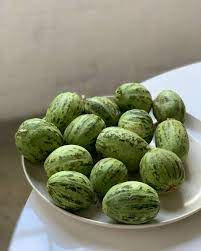
Mandurian Round: A slicer from Southern Italy, with fast growth is harvested when at 2-2.5 inches long. It has a light green with dark ridges and develops fuzz on maturity. It produced to be burpless.

Tendergreen: This is an heirloom slicer variety developed by the Eden Bros. It is a fast growing variety, which bears cukes growing upto 8 inches long and has dark green, thin skin with very few seeds. Tendergreen cukes are harvest ready till 55 days post plantation.

Garden: Common slicer variety in North America with a smooth and dark green skin. The skin is thick, bitter and waxed for moisture retention before selling. Due to the reasons mentioned, this cuke is eaten peeled and also deseeded to get rid of the big seeds embedded in the flesh.

Corinto: It is an organic hybrid which grows upto 7-8 inches with a thick dark green skin along with small seeds. It is cultivated to be highly productive and resistant to diseases like mildew, yellowing virus, cucumber mosaic virus, etc.

Kirby: A thin and bumpy skinned pickler which grows upto 6 inches with a crisp texture and a mild flavour. The skin varies form yellow to dark green. Kirby can be used in cold soups and salads even though it’s a pickler.

Gherkin: These small, stubby picklers are a common accompaniment to pate and other dishes of the French cuisine. The pickled gherkins are called ‘Cornichous’ in the French cuisine. It has a light green bumpy skin and grows upto 2-3 inches long. These pickles are used in sandwiches, toppings and cocktail garnishes.

Korean: It is a pickler variety with a crunchy, juicy, firm and sweet flesh. It has a dark to light green bumpy skin and grows upto 18 inches long. It is commonly pickled but can also be sauted with sesame seeds after drawing out its juices. This variety can be used in a versatile way as it retains its taste and crunchy texture.

Northern Pickling: It is a short, stumpy and stout pickler variety which grows in cold climates with a short duration harvest and can be cultivated in small patches as it is not a sprawler and has small leaves. The skin is yellowish green with bumps and yellow veins.

Maroon: An African native, with several names like 'Maxise Burr gherkin, West Indian gherkin, West Indian gourd and Cackery', grow on a vine which can climb upto 10 ft. Cucumis Anguria is a fast growing variety which bears oblong, 1.5-2 inches long and 1 inch wide fruits with light spines on a tender green skin with pale green flesh. It is used in salads and pickled commonly.

Burpee: A black spined, medium green pickler variety which grows upto 3-5 inches before being harvest ready till 53 days. It has blunt edges with a bumpy skin.
Here are some exceptional varieties which fall under both categories of slicers and picklers:

Persian: It is used as slicer and pickler. Its similar to English cucumbers but are shorter than English slicers. They have a thin skin, mild flavour, crunchy and firm flesh with a very few seeds embedded. This burpless pickler cuke is used in stir-fries, toppings, garnishes, salads and pickles.

Lebanese: These are sweet and plump with a thin green skin. They grow to be upto 16 inches long. This pickler cum slicer variety is a versatile one and is used in soups, coolers, salads, pickles, etc.
Here is an image to show the difference between these similar cucumbers mentioned : Persian, Japanese and English.

Pickling varieties were first cultivated and used for pickling by the Mesopotamians in the year 2400 BC then reached the Tigris Valley, centuries later. In 1876, Henry J. Heinz added pickled cucumbers to the list of food processed in his company, resulting a boost in its popularity. This was an addition to the monotonous European diet of meat and potatoes. Europe then added the Sumatra originated dill to the pickles introducing another dimension of flavour. Pickles got in demand in many countries for different usages like, for beauty in Egypt- popularised by Cleopatra, for strength in Rome- was included in the diet of roman soldiers, it was stocked up in voyages to prevent and fight vit C deficiency diseases in sailors off land, a kosher version was made for the Jewish and other communities who consumed only kosher food products in America, the pickle juice was consumed by sport players and athletes to heal cramps faster and re-energize.
Other than processing, cucumber is consumed majorly uncooked in many cuisines, in the from of salads, sandwiches, dips, chutneys, coolers and cold soups like cucumber gazpacho, cucumber and prawn soup, etc. It is stir-fried in oriental cuisine with sesame seeds, garlic, used in spring rolls and cucumber salmon rolls called as Kapa Maki. It is used famously in roman cuisine to toss up a popular roman side dish which is made by stir-frying squeezed cucumber slices with oil, vinegar and honey, preferably served as a side to grilled tuna. Cucumber is used as an ingredient to make chutneys only in Indian cuisine, mainly in Andhra and Malayali cuisine. It is used in pachadis (raita with tempering), an Andhra style tomato chutney, dosakaya keera (cucumber tomato curry) which uses the ‘Madras/Sambhar cucumber’. This cucumber is also cooked with pulses to make a stew, curries, chutney, sambhar, etc. Madras cucumber is instructed to be used in unripe form when it is firm and not so tangy, these cucumbers are tangy in taste. If it is used in its mature from, other ingredients like tomato or tamarind to prevent the dish from getting too tangy. A stew made of cukes and vegetables is a famous comfort food from the Malayali cuisine. The pickling culture of India will surely not leave out cucumber- a popular pickler. Mentioned varieties like maroon cucumbers are used in making achaar in the Punjab region. Cucumber is also used in kachumbar/koshimbir- salad of chopped cucumber, onions and tomatoes generally, many variations are created by adding different vegetables. Khamang kakdi is a cucumber, fresh coconut and peanut salad. A south Indian salad- Kosambari- made with cucumber, moong dal and coconut, is made on special occasions.
Cucumber is not just a cool culinary ingredient but also has great worth on the medicinal section. Allopathically, it is most preferred due to its capability of curing and preventing different diseases but also it is easily available. 96% of cucumber is made up of water i.e., 137 gm of water, 17 gm calories, 0.8 gm protein, 0.2 gm fat, 3.1gm carbohydrates including 2 gm sugar, 1 gm fibre and rest is vitamins and minerals like calcium, iron, magnesium, phosphorous, potassium, sodium, vitamin B, C and K in 1 cup of diced cucumber. It is already posing as a healthy ingredient bring low in calories, fat, cholesterol and sodium. Cucumber helps treating osteoarthritis, decreasing cholesterol and hyperlipidemia (increased levels of fats in blood), reduces inflammation, cooling skin, reducing eye puffiness, also works a toner and a face pack. Cucurbitacins play a role to prevent cancer by eliminating cancer cell reproduction. These compounds also regulate insulin release and metabolism of hepatic glycogen, which is a key hormone in processing blood sugar. Cukes have a low GI (glycemic index) which makes them fit for diabetic people. The peel and fibre prevent colorectal cancer, controls cholesterol and controls blood pressure. Vitamin K present in cucumbers thicken blood and hence are recommended to heal wounds, it also helps in calcium absorption and supports bone health. The vitamin C and silica present improve hair and nails and prevent them from turning brittle. Cucumber has phytonutrients which destroy bacteria present in the mouth and cures bad breath.
With many benefits, excess of cucumber can cause side-effects too. Excessive consumption of cucumber can cause bloating, flatulence, not fit for people with kidney diseases due to the high water and potassium content, now fit for people taking blood thinners due to the blood clotting capacity of vit K present, people who are allergic to cucumbers can get hives, swelling of oesophagus which can lead to difficulty in breathing.
Ayurveda describes cucumber or ‘Trapusha’ in parameters of:
Rasa(taste): Madhura(sweet)
Guna- Laghu(light)
Vipaka- Madhura(undergoes sweet taste after digestion)
Veerya(potency): Sheeta(cold)
Karma- Pitta Hara(reduces pitta)
Cucumber seed, skin and pulp have their separate ayurvedic importances. A yellow ripened cucumber promotes hair growth and eliminates hair fall when applied to the scalp. This is due to the fact that cucumber balances the vata dosha of our body.
Cucumber pulp and skin is prescribed to fight Trushna- excessive thirst, Klama- fatigue, Daha- burning sensation as in gastritis and burning sensation in eyes, Raktapitta- bleeding disorders, nasal bleeding, heavy periods, Chardi- vomiting, Bhrama- dillusion , dizziness.
Cucumber seeds are prescribed in Raktapitta, Mutrakrichra- painfull urination, Dysuria, Mutrala- diuretic.
Cucumber has many names, some are derived by its medicinal benefits, like:
Vistambhi Ahara- Constipation food to treat loose motions
Sheetala- Coolant
Mutrala- Diuretic
Bastishodhana- Cleanses urinary bladder.
Other names:
Sudhavas: White pulp
Kantala, Kantaki phala: Wild variety of cucumber, has small spikes on its skin
Susheetala- Natural coolant fruit
Peetapushpi- Has yellow flower
Some other names are Koshaphala, Tundilaphala, Muni, etc.
Cucumber is deeply infused in Indian culture due to its many centuries old usage and prescription in Ayurveda. It is referred with various names throughout Bharat, like:
Kheera(hindi), Shasha(Bengali), Southekai(kannada), Vellarikka(malayam), Tansali, Kakdi(gujarati), Muhivettin Keerakai, Vellarikai(tamil), Ujakaipa
" Hope, by the end of this article, I have uncovered many unfamiliar facts about this vegetable, its various names and uses across the globe, history and origin and introduced my readers to various types of cucumbers other than the one we use in our daily food consumption. Keep reading to discover information about many other veins of food, which seem to be known but still have many facts uncovered."


Comments